Vidwave Pricing 2026 – Plans, Costs & Free Trial
Executive Summary: Is Vidwave Worth the Cost in 2026?
The artificial intelligence video generation market has undergone a dramatic stabilization phase in 2026. Following the high-profile and abrupt discontinuation of OpenAI’s Sora 2 in April 2026—a move precipitated by insurmountable compute costs, staggering GPU burn rates estimated at $1 million per day, and unresolved intellectual property liabilities—the industry has shifted its focus from unbridled capability to sustainable unit economics. Amidst this rapidly consolidating landscape, Vidwave has solidified its position as a highly accessible, rapid-deployment text-to-video and image-to-video platform. Current market sentiment and professional software review aggregators indicate that Vidwave maintains a robust average user rating hovering between 4.3 and 4.8 out of 5, particularly praised for its mobile-first interface and integrated audio features.
For highly intent-driven buyers—ranging from social media marketers and independent content creators to boutique digital agency owners—the fundamental question is no longer whether AI video works, but whether it is profitable. The bottom line assessment indicates that Vidwave is a formidable asset, provided the user thoroughly understands its underlying tokenomics. The platform is best utilized by professionals prioritizing high-volume, short-form content optimized for vertical platforms like TikTok, YouTube Shorts, and Instagram Reels, rather than those seeking the granular, Hollywood-style camera controls offered by more complex node-based editors.
While Vidwave’s marketing aggressively highlights its "Free Forever" tier and low barrier to entry , serious commercial deployment necessitates upgrading to the Pro or Ultimate subscription tiers. These premium plans are required to bypass rigid compute bottlenecks, access unwatermarked 1080p and 4K resolutions, and secure the commercial rights necessary for monetization. Vidwave justifies its 2026 price point through lightning-fast rendering architectures, seamlessly integrated AI voice and ambient audio synthesis , and an intuitive workflow that drastically reduces the traditional post-production timeline. However, buyers must remain acutely aware of the platform's strict no-refund policy regarding failed algorithmic generations , a structural reality that directly impacts the true return on investment and requires careful credit management.
The Macroeconomics of AI Video Generation in 2026
To accurately evaluate the cost-effectiveness of Vidwave's subscription models, it is essential to contextualize the pricing within the macroeconomic realities of cloud-based generative artificial intelligence in 2026. Generating highly temporally coherent, physics-aware video is an immensely computationally expensive endeavor that requires access to massive, specialized graphics processing unit (GPU) clusters. Traditional video production workflows, involving location scouting, equipment rentals, talent acquisition, and extensive post-production, can command budgets ranging anywhere from $1,000 to $50,000 per minute of finalized footage. In stark contrast, cloud-based AI generation has aggressively compressed this financial baseline to between $0.50 and $30 per minute of output, representing up to a 90% reduction in production overhead and democratizing access to high-fidelity visual media.
However, this unprecedented cost reduction introduces new forms of structural friction. The compute required to run advanced latent diffusion models or spatial-temporal transformers cannot be offered at a flat, unlimited rate without risking severe financial hemorrhaging for the service provider. To prevent the operational losses that ultimately doomed platforms like Sora 2 , commercial entities including Vidwave, Runway, and Kling have universally adopted credit-based micro-economies.
Instead of paying a flat fee for unmetered server access, users purchase computing tokens. This architectural decision fundamentally shifts the financial risk of AI hallucinations from the software provider to the end-user. If an algorithm generates a sequence featuring severe anatomical anomalies, physics-defying artifacts, or complete prompt deviation, the user still forfeits the credits consumed by the GPU during the rendering process. The compute power was expended, regardless of the artistic utility of the output. Understanding this paradigm is the foundational requirement before evaluating the specific subscription tiers offered by Vidwave, as the nominal price per month rarely reflects the actual cost of producing polished, client-ready deliverables.
Vidwave Pricing Plans Explained (The 2026 Breakdown)
As of 2026, Vidwave has structured its pricing matrix into a tiered subscription model meticulously designed to capture a wide spectrum of the market, from weekend hobbyists experimenting with prompt engineering to enterprise-scale marketing agencies requiring automated video pipelines. The platform heavily incentivizes annual billing commitments, offering substantial discounts to secure recurring revenue and stabilize their own cloud compute forecasting.
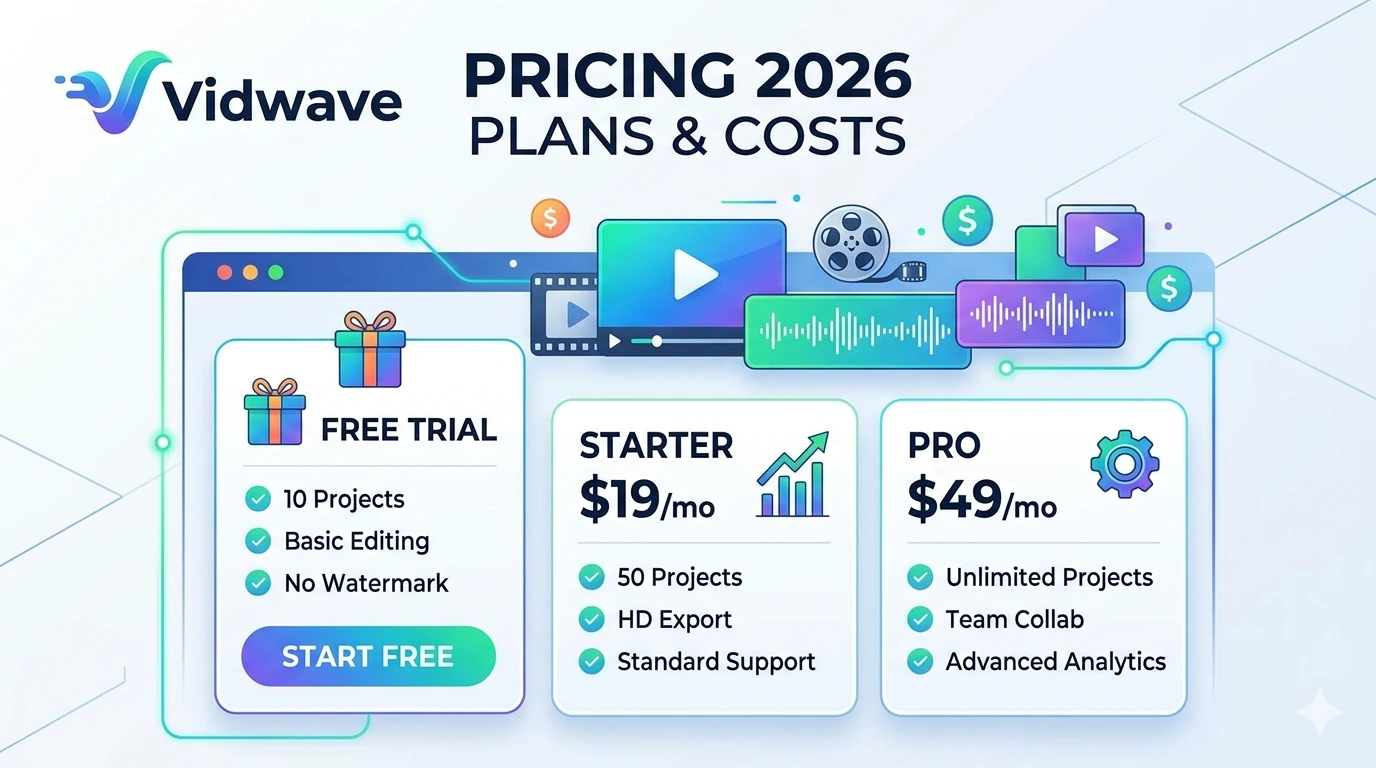
Vidwave 2026 Plan Tier | Monthly Cost (Estimated USD) | Core Features Included | Best Suited For |
Free Trial | $0.00 | One-time credit allocation, 720p maximum resolution, visible digital watermarks, restricted commercial rights. | Initial software evaluation and casual experimentation. |
Starter Plan | ~$14.99/month | Fixed monthly credit allowance, 1080p high-definition exports, watermark removal, standard generation queue. | Casual creators, hobbyists, and low-volume users. |
Pro Plan | ~$29.99/month | High-volume monthly credits, native 4K Pro-Grade upscaling, fast-lane priority generation, integrated AI audio engine. | Full-time content creators, YouTubers, and freelance marketers. |
Ultimate Plan | ~$79.99/month ($299.00/annually) | Massive credit allocations, unlimited relaxed-rate generations, concurrent job processing, enterprise support options. | High-volume marketing agencies and professional digital studios. |
The Basic/Starter Plan (Best for Hobbyists)
Positioned at an accessible entry point of approximately $14.99 per month (with equivalent localized pricing structures such as RM69.90 observed in specific regional app store deployments ), the Starter Plan operates as the bridge between casual experimentation and serious usage. It is explicitly engineered for creators, digital artists, and small business owners who are transitioning away from the limitations of the free tier but do not possess the content pipeline to justify heavy daily output.
The most critical upgrade unlocked by the Starter Plan is the transition to 1080p high-definition video generation, a stark necessity given the compression algorithms utilized by major social networks, alongside the complete removal of the Vidwave branding watermark. Users subscribing to the Starter Plan are allotted a fixed pool of monthly credits. Based on standard industry consumption rates for transformer models, this allocation typically translates to the successful generation of approximately 15 to 25 ten-second clips per month, heavily dependent on the complexity of the prompt and the ratio of text-to-video versus image-to-video operations.
Despite the removal of the watermark, the Starter Plan introduces notable workflow friction that professional users must consider. Generations initiated on this tier are relegated to a "standard" or "relaxed" compute queue. During periods of peak global server load, users may experience wait times spanning several minutes for a single short-form clip to render. Furthermore, access to the most computationally intensive 2026 feature drops—such as native phoneme-level lip-syncing and complex multi-shot storyboarding utilizing the newest underlying AI models—may be restricted, throttled, or demand a disproportionately high credit premium on the Starter tier.
The Pro Plan (Best for Creators & Marketers)
The Pro Plan, hovering at the $29.99 per month price point, represents the undisputed operational sweet spot for serious content creators, automated YouTube channels, and freelance social media managers managing multiple client accounts. By committing to the annual billing cycle, subscribers typically capture cost reductions ranging from 20% to 30%, which significantly lowers the effective monthly expenditure and dramatically improves the mathematical credit-to-dollar ratio.
The most vital capability locked behind the Pro Plan is "Fast-Lane" priority generation. In the hyper-accelerated realm of digital content creation, waiting in a server queue destroys creative momentum and drastically reduces hourly productivity. The Pro Plan circumvents this by granting priority GPU cluster access, ensuring that complex clips render in seconds rather than minutes. Additionally, this tier unlocks the platform's Pro-Grade Upscaling algorithms, empowering users to export broadcast-ready 4K resolution videos natively. Crucially, these outputs can be formatted in the optimal 9:16 vertical aspect ratio required for algorithmic success on TikTok and Instagram Reels, eliminating the need for destructive post-generation cropping.
The credit allocation provided on the Pro tier is robust enough to support the generation of 80 to 100 short-form clips per month. For a dedicated social media marketer requiring 20 clips per week at an average duration of eight seconds and enhanced visual fidelity, the Pro plan provides sufficient mathematical headroom to absorb the cost of experimental prompts and inevitable algorithmic generation errors. Furthermore, this tier fully integrates Vidwave's proprietary AI Audio Engine. This system automatically generates contextual background music, ambient environmental soundscapes, and lifelike, synthesized voiceovers that are perfectly synchronized to the visual output, effectively eliminating the need for third-party audio licensing or separate text-to-speech subscriptions.
The Ultimate/Enterprise Plan (Best for Teams & Agencies)
For high-volume marketing agencies, enterprise communication teams, and professional animation studios, Vidwave offers the Ultimate Plan, which commands a premium price of approximately $79.99 per month, though heavily discounted annual options frequently bring the effective cost down to around $299.00 per year depending on regional promotional cycles.
The defining characteristic of the Ultimate tier is the systematic removal of the psychological and financial friction associated with rigorous credit counting. While the tier continues to utilize a credit system for high-priority, ultra-HD generations—offering tens of thousands of premium credits per billing cycle—it fundamentally alters the workflow by introducing unlimited relaxed-rate generations. This "Explore Mode" functionality permits an agency art director to batch-generate hundreds of b-roll clips, background assets, and concept tests over a weekend without continuously depleting the organization's premium credit pool.
Moreover, the Ultimate tier supports concurrent job processing architectures. A single enterprise user can queue up multiple, disparate prompts simultaneously, drastically accelerating the pre-production and ideation phases of a campaign. For corporate organizations bound by strict data compliance and privacy requirements, Vidwave’s enterprise-level deployments offer custom Service Level Agreements (SLAs), dedicated rendering queues isolated from public traffic, and explicit data processing addendums to ensure that proprietary agency prompts, brand kits, and uploaded reference images are legally shielded and not utilized to train future iterations of the platform's public AI models.
The Vidwave Free Trial: What Can You Actually Do?
The allure of a "Free Forever" AI video generator serves as a highly potent marketing mechanism, and Vidwave leverages this positioning heavily within its top-of-funnel user acquisition strategy. However, the operational reality of the free trial in the 2026 AI landscape is heavily circumscribed by the sheer, unavoidable financial cost of cloud GPU rendering.
Vidwave excels in onboarding by allowing users to commence video generation without the immediate friction of providing a credit card. Upon account creation, users are granted a small, one-time allocation of evaluation credits. Unlike certain competitive platforms that operate on a freemium model offering a replenishing daily drip of free tokens (such as Kling 3.0’s highly publicized 66 daily credits ), Vidwave’s free trial credits are generally structured as a singular, non-rolling allocation meant purely for initial software evaluation. Once this initial pool of compute tokens is exhausted, the user encounters a hard paywall.
The outputs successfully generated on the free tier are subjected to several strict technical and legal limitations. From a technical standpoint, generations are artificially confined to lower resolutions, typically capped at 720p or 480p. While sufficient for mobile previewing, these resolutions are entirely inadequate for professional broadcasting, high-end brand marketing, or display on modern 4K monitors. Secondly, the generation speed for free users is relegated to the lowest priority tier within the server architecture. During times of high global traffic, free users will experience significant rendering delays, as the load balancers actively prioritize the compute requests of paying Pro and Ultimate subscribers.
Crucially, the commercial rights associated with the free tier require careful legal navigation by any entity intending to monetize the output. The United States Copyright Office established definitive legal precedents in 2025 and early 2026 regarding AI-generated content, ruling that visual output generated entirely from a text prompt, devoid of meaningful human editing or arrangement, resides firmly within the public domain. While Vidwave’s overarching Terms of Service grant users a worldwide, royalty-free license to use, download, and publish their generated outputs , the free tier is inherently restrictive due to the automated application of visible digital watermarks.
Most AI platforms, including Vidwave and its contemporaries, strictly prohibit the commercial utilization of watermarked content generated on their free evaluation tiers. If a creator attempts to run a monetized YouTube channel or a paid social media advertising campaign using watermarked free-tier footage, they operate in direct violation of the platform's licensing agreements. Furthermore, any attempt to bypass the watermark, utilize the platform to generate deepfakes, impersonate unauthorized individuals, or create explicit material constitutes an immediate violation of the acceptable use policy, resulting in swift account termination and potential legal liability.
Ultimately, the Vidwave free trial functions as an excellent sandbox. It provides the necessary environment for testing prompt adherence, exploring the platform's diverse array of aesthetic capabilities—ranging from photorealistic to cinematic, cyberpunk, and anime styles —and determining if the user interface seamlessly integrates with one's existing creative workflow. It is not, however, a sustainable, legally sound, or technically viable avenue for continuous commercial content production.
Decoding the Vidwave Credit System & Hidden Costs
The industry-wide transition from flat-rate SaaS software models to highly variable, credit-based generative AI systems has introduced an unprecedented layer of complexity to corporate budget forecasting. To accurately assess the return on investment (ROI) of deploying Vidwave at scale, buyers must decode precisely how the internal credit economy translates into usable seconds of video time. More importantly, they must account for the hidden costs of AI operational friction, which rarely appear on the platform's primary pricing page.
How Credits are Consumed (Standard vs. High-Quality Generations)
Credits within the Vidwave ecosystem are not a simple, 1:1 equivalent to seconds of video generated; rather, they serve as a dynamic proxy for the volume of GPU compute time required to execute a specific prompt. Generating a standard five-second video at 1080p resolution from a basic text prompt will consume a baseline number of credits. However, toggling advanced generation parameters acts as a compounding multiplier on this baseline cost.
For example, generating a video purely from a text prompt (Text-to-Video) is computationally less demanding than animating a highly detailed, user-uploaded static photograph (Image-to-Video) while maintaining strict adherence to the reference image's geometry and enforcing complex, user-directed camera motion. If a creator opts to activate Vidwave's AI Audio Engine to synthesize natively synchronized voiceovers, ambient environmental soundscapes, and background music alongside the video , the credit cost per generation increases significantly to account for the parallel audio synthesis models running in the background. Furthermore, pushing the final output through the Pro-Grade Upscaler to achieve true, broadcast-ready 4K resolution can easily double or triple the initial credit expenditure.
To calculate the "true cost per minute" of AI video on Vidwave, we can extrapolate from the metrics of the Pro Plan. Assuming the $29.99 monthly cost yields a hypothetical baseline of 1,000 credits, and a standard ten-second high-definition clip consumes roughly 50 credits (averaging 5 credits per second, which aligns with standard industry benchmark costs for mid-tier diffusion models in 2026 ). Under perfect conditions, this allocation means the user can generate 20 discrete ten-second clips, totaling 200 seconds (or 3.33 minutes) of usable footage. Mathematically, the true base cost is approximately $9.00 per minute of generated content. While this is vastly more economical than hiring a live-action film crew or licensing premium stock footage, it represents a tangible, scalable cost that can spiral rapidly if creative workflows are inefficient.
The "Failure Tax": Why ROI Calculations Often Fall Short
The most contentious and widely debated hidden cost within the 2026 AI video landscape is the financial penalty exacted upon users for AI hallucinations and algorithmic failures. Generative video models are inherently probabilistic; they operate on statistical likelihoods rather than a deterministic understanding of real-world physics. A prompt requesting a "man walking a dog in a park" may result in a flawless, cinematic tracking shot on the very first attempt. Conversely, it may result in a horrifying, uncanny mutation where the dog seamlessly merges into the man's leg, or the background geometry spontaneously dissolves.
When a generation fails catastrophically due to these algorithmic limitations, the user is still billed for the attempt. Vidwave's official refund policy is uncompromising and standard for the industry on this front: "No refunds are available once GPU usage or video generation has been initiated". Because the cloud computing resources were successfully executed by the server, the transaction is considered fulfilled by the provider, regardless of the visual utility of the resulting file.
In real-world commercial production, art directors and editors frequently must generate a specific prompt three to five times, tweaking keywords and adjusting parameters, to secure a single, client-ready take. If an advertising agency requires 10 finalized clips for a campaign, they must realistically budget their credit consumption for 30 to 50 generations. This failure rate acts as a massive hidden tax on the credit system, effectively multiplying the true cost per minute calculated above by a factor of three or four. While Vidwave does offer a standard 7-day money-back guarantee, the terms explicitly state that this applies solely to the base subscription fee and only if the purchased credits remain entirely unused.
Add-Ons and Top-Ups: When You Run Out of Credits
For creators and agencies who miscalculate their monthly usage requirements or experience an unusually high rate of algorithmic failures, hitting the credit ceiling mid-project is a common and highly disruptive frustration. Vidwave addresses this operational bottleneck via micro-transactional top-ups. Users can purchase standalone Credit Packs to bridge the generation gap until their monthly subscription billing cycle renews.
Market data across similar applications indicates these top-ups are structured in tiered pricing, offering options such as a small injection of 5,000 credits for $9.99, scaling up to massive enterprise top-ups of 100,000 credits for $99.99. While undeniably convenient for maintaining project momentum, relying on mid-cycle top-ups is structurally the least economical methodology for utilizing the platform. The cost-per-credit on standalone packs is invariably higher than the bulk rate heavily subsidized and embedded within the annual Ultimate or Pro subscription plans.
Vidwave vs. The Competition: A 2026 Market Comparison
Evaluating Vidwave's pricing and feature set in absolute isolation is insufficient for professional decision-making; its overarching value proposition must be ruthlessly contextualized against the heavyweights of the 2026 AI video ecosystem. The market has consolidated dramatically since the explosive growth phases of 2024 and 2025, leaving four distinct paradigms of video generation, each catering to a highly specific user profile.
AI Video Model | Target Audience & Core Strength | Pricing Style & Entry Cost | Max Resolution & Speed | Native Audio Integration |
Vidwave | Social Media Creators, Agencies (Mobile/Web Hook Generation) | Subscription + Credits (~$14.99/mo) | 4K (Upscaled), Fast-Lane Priority | Yes (Background Music & Voiceovers) |
Runway Gen-4.5 | Professional Filmmakers, Video Editors (Granular Creative Control) | Subscription + Credits ($15.00/mo) | 4K (Upscaled), Rapid Iteration | Limited (Requires discrete Act Tools) |
Kling 3.0 | Commercial Producers (Unmatched Physics & Character Consistency) | Subscription + API ($6.99/mo) | 1080p Native (4K on Pro), Relaxed | Yes (Spatial Audio & 5 Languages) |
Google Veo 3.1 | Google Ecosystem Users (Photorealistic Realism & Sync) | Subscription via Google AI Pro ($19.99/mo) | 4K Native, Relaxed | Yes (Best-in-class Lip Sync) |
The Post-Sora Landscape
The defining macroeconomic event of the year was OpenAI's abrupt decision to permanently shut down both the web interface and API access for Sora 2 in April 2026. Despite possessing industry-leading narrative coherence capabilities and securing a highly publicized $1 billion enterprise partnership with Disney, Sora 2's underlying architecture proved too computationally expensive to sustain at scale, reportedly burning millions of dollars a week in baseline operating costs. The death of Sora left a massive capability void at the top of the enterprise market, which specialized, highly optimized platforms rushed to fill, prioritizing efficient token processing over sheer model size.
Vidwave vs. Kling 3.0
Kling 3.0, developed by Chinese technology giant Kuaishou, is widely considered the undisputed 2026 champion of physical realism and anatomical consistency. Utilizing a breakthrough spatial-temporal attention mechanism, Kling effectively prevents the notorious "melting" and morphing effects that traditionally plague longer AI videos. Kling offers an incredibly aggressive and highly disruptive pricing model, starting at just $6.99 per month for standard access and providing a remarkably generous daily drip of 66 free credits for non-paying users. Furthermore, utilizing its advanced AI Director modes, Kling can generate coherent clips up to an astounding 2 to 3 minutes in length, far surpassing industry norms.
Where Vidwave decisively beats Kling is in workflow velocity and user accessibility. Kling’s highly complex interface and frequently saturated generation queues can severely bog down the rapid iteration required for daily social media workflows. Vidwave’s native vertical (9:16) rendering architecture and integrated repository of viral aesthetic templates make it a vastly superior engine for creators tasked with pumping out daily TikToks, YouTube Shorts, and Instagram Reels without requiring extensive post-production conformities.
Vidwave vs. Runway Gen-4.5
Runway Gen-4.5 remains the indispensable tool of choice for "control freaks," visual effects artists, and traditional narrative filmmakers. Equipped with a suite of professional features like the Multi-Motion Brush, Advanced Camera Controls, and the Act-Two performance capture system, Runway empowers directors to dictate exact dolly, pan, truck, and tracking movements with mathematical precision. However, this power comes at a premium. Runway is significantly more expensive to operate at scale, featuring a standard plan at $15 per month, a Pro plan at $35 per month, and an Unlimited tier at $95 per month. Its strict credit burn rate—costing up to 12 credits per second for Gen-4.5 output —makes sustained experimentation incredibly costly.
Vidwave, lacking the granular motion brush controls and timeline timeline manipulation of Runway, cannot compete for high-end cinematic post-production or complex visual effects compositing. However, for a performance marketer who simply requires a text prompt translated into a high-retention visual hook—without the burden of manually keyframing motion vectors—Vidwave is an infinitely more cost-effective and streamlined solution.
Vidwave vs. Google Veo 3.1
Google Veo 3.1 represents the pinnacle of raw photographic realism and native audio synchronization. Seamlessly bundled into the $19.99 per month Google AI Pro (Google One) tier, it offers incredible value for enterprise users and creators already deeply embedded within the Google Workspace ecosystem. However, Veo is encumbered by heavy corporate filtering; Google’s draconian safety guardrails frequently flag and block prompts that are entirely benign but trigger overzealous automated content violation algorithms, resulting in a frustrating user experience. Furthermore, Veo structurally limits standard generations to concise 4 to 8-second bursts. Vidwave operates with a much more flexible and permissive prompt engine, granting creators wider creative leeway to explore aesthetic concepts without facing the constant friction of algorithmic rejection.
Which Vidwave Plan is Right for You? (Buyer’s Guide)
Deciding to invest capital in a Vidwave subscription requires a ruthlessly honest audit of your daily content pipeline and technical requirements. The AI video market is littered with the sunken costs of users who overpaid for Enterprise tiers they never fully utilized, or conversely, users who artificially throttled their own channel growth by stubbornly clinging to restrictive, watermarked Free plans.
If You Make YouTube Shorts / TikToks...
Recommendation: The Pro Plan ($29.99/month)
The economics of short-form, algorithmically driven video demand both high volume and high audience retention. If you are operating a faceless automation channel, a deep-dive lore channel, or producing daily reaction and commentary clips, you are likely producing between 15 and 30 discrete videos a month. The Starter plan simply will not provide enough computing credits to handle the inevitable re-rolls and algorithmic failures required to secure a perfect, hook-driven output.
The Pro Plan’s fast-lane rendering is an absolute necessity here; social media trends and audio trends move in hours, not weeks, and waiting in a server queue is a critical disadvantage. Furthermore, the native 9:16 vertical output capability ensures you are not wasting valuable production time cropping 16:9 cinematic outputs and sacrificing resolution in external editors like CapCut or Premiere Pro. Critically, the integrated AI voiceovers and ambient audio engine eliminate the need to secure and pay for a secondary, specialized Text-to-Speech subscription like ElevenLabs, effectively saving the creator an additional $10 to $22 per month and consolidating the workflow.
If You Run a Marketing Agency...
Recommendation: The Ultimate/Enterprise Plan ($79.99/month or Annual Equivalent)
Modern digital advertising agencies live and die by their operating margins and their client turnaround times. When pitching a complex visual concept to a prospective client, an agency art director might need to generate 40 different variations of a B-roll shot just to construct a compelling, cohesive mood board. Relying on strictly metered credits creates profound psychological friction and actively discourages the creative exploration necessary to produce award-winning campaigns.
The Ultimate tier’s inclusion of an "Explore Mode" or relaxed-rate unlimited generation capability allows creative teams to experiment, fail, and iterate without watching a financial meter tick downward toward zero. Furthermore, the explicit commercial licensing guarantees and data privacy addendums provided at the Enterprise level are non-negotiable. They legally protect the agency and their clients from copyright liabilities when deploying AI-generated assets in highly visible paid media campaigns across Facebook, Instagram, or traditional broadcast television.
If You Are a Filmmaker/Animator...
Recommendation: Look Elsewhere (or Use Vidwave’s Starter Plan for Storyboarding) If your ultimate goal is to produce a 10-minute, festival-ready short film requiring flawless character continuity across dozens of scenes, precise millimeter control over focal lengths, and complex, multi-axis camera movements, Vidwave is likely not your primary production tool. Traditional narrative filmmakers are much better served by investing in the granular control suite and advanced inpainting capabilities of Runway Gen-4.5 or leveraging the unprecedented multi-shot timeline coherence and physical accuracy of Kling 3.0.
However, Vidwave’s entry-level Starter Plan serves as an exceptional, highly cost-effective pre-visualization tool. Directors and cinematographers can utilize Vidwave's rapid generation capabilities to build dynamic, full-color, animated storyboards and pitch decks. This allows filmmakers to translate dry script pages into vivid, emotionally resonant visual proof-of-concepts in seconds, serving as a powerful tool to present to producers and secure traditional funding.
Frequently Asked Questions (FAQ)
Can I cancel my Vidwave subscription anytime? Yes, subscriptions can be managed and canceled at any time directly via the user account dashboard. When a cancellation is initiated, it does not result in immediate account termination. Instead, the cancellation will take effect at the exact end of the current, pre-paid billing period. Users will retain full, unhindered access to all of their paid features, high-resolution export capabilities, and remaining compute credits until that specific billing cycle concludes.
Do unused Vidwave credits roll over to the next month? This is a critical financial nuance in the economics of AI video pricing. In general, standard monthly credit allocations provided as part of a recurring subscription tier do not roll over indefinitely. Similar to the strict operational policies enforced by industry peers like Runway, a rigid "use it or lose it" policy is enforced at the end of each 30-day billing cycle. This policy is designed to prevent users from hoarding massive reserves of server compute rights, which makes infrastructure scaling difficult for the provider. However, any supplementary, standalone "Credit Packs" purchased as top-ups typically remain active in the account until they are fully consumed, as they are decoupled from the monthly recurring subscription limit.
Are refunds available for accidental renewals or failed generations? Vidwave maintains a standard 7-day money-back guarantee, but its application is highly conditional and legally narrow. A user is only eligible for a financial refund on a subscription fee or a standalone credit purchase if the credits remain completely and totally unused. The exact moment a user initiates a video generation—even a single, low-resolution test clip—expensive GPU resources are spun up and consumed, and the purchase immediately becomes strictly non-refundable. There are absolutely no refunds, credit rollbacks, or reimbursements provided for generations that result in AI hallucinations, anatomical errors, physics failures, or a lack of strict prompt adherence. The user bears the financial risk of the generation.
Do I own the commercial rights to my Vidwave videos? Yes, under the current Terms of Service effective in 2026, Vidwave explicitly grants paying users a worldwide, royalty-free license to download, edit, distribute, and financially monetize any video output successfully generated through a paid account tier. However, the platform strictly prohibits the generation of copyrighted intellectual property owned by third parties, the creation of unauthorized deepfakes, or the generation of explicit material, all of which will result in account bans. Crucially, commercial rights are generally restricted, nullified, or legally murky if the user remains on the Free Trial tier and attempts to monetize content that bears the mandatory digital watermark.
Conclusion: Navigating the 2026 AI Economy
The artificial intelligence video generation landscape of 2026 is a marvel of rapid technological acceleration, defined simultaneously by stunning visual fidelity and highly complex, opaque pricing ecosystems. In the wake of Sora 2's collapse, Vidwave has successfully carved out a powerful, highly profitable niche by democratizing access to high-end cloud rendering. By intentionally obfuscating the intense complexities of latent diffusion models and spatial-temporal transformers behind an intuitive, mobile-optimized interface, it empowers marketers, agency owners, and social creators to generate compelling, native-vertical content at unprecedented speeds.
However, navigating the "freemium illusion" of the modern generative SaaS market requires buyers to be highly analytical and ruthlessly protective of their budgets. The true, operational cost of Vidwave is not found neatly displayed on the pricing page. It is discovered in the mathematical reality of its credit burn rate, the lack of financial refunds for algorithmic failures, the upscaling multipliers, and the absolute necessity of fast-lane GPU access for professional, time-sensitive workflows. For those who respect the underlying tokenomics, account for the inevitable failure tax, and select a subscription plan aligned perfectly with their exact output volume, Vidwave represents a massive return on investment. It is a tool capable of reducing video production from a multi-day logistical nightmare into a frictionless, highly iterative, and deeply creative process.


